
If your air conditioning is running but the room still feels warm, it can be hard to tell whether it’s just a setting issue or something that needs professional attention. Maybe the airflow feels weaker than usual, the unit is blowing warm air, or the temperature never reaches the temperature you pick.
If you have noticed your air conditioning not cooling properly, there are a few things you can safely check before arranging a repair. Understanding the possible causes will also help you explain the problem to an engineer and avoid paying for unnecessary work.
Is Your Air Conditioning Really Not Cooling?
Before assuming something is wrong, make sure you give your system a few minutes to respond after switching it on or changing the settings. Some units will take a short time to begin delivering noticeably cool air, especially if the room is very warm.
Consider what has changed. If your air conditioning used to cool the room fine but is now struggling, it may have a developing fault. Weak airflow, unusual noises, water leaking from the indoor unit or ice forming around the equipment can all be useful clues.
Also, take into account room conditions, as strong sunlight, open windows, several people in the space, or heat from cooking and electrical equipment can make it harder to maintain your preferred temperature.
However, if your air conditioning still isn’t cooling properly despite these factors, don’t keep lowering the temperature in the hope it will fix the problem. A fault affecting airflow, the refrigerant circuit, or an internal component may need investigation.
Simple Checks to Try Before Calling an Engineer
A few basic checks can help you rule out straightforward problems without taking the unit apart. Always follow the manufacturer’s instructions and avoid touching electrical components or refrigerant pipework.
- Check the Mode and Temperature Setting
Start with the remote control or wall controller. Make sure the unit is set to cooling rather than fan-only, heating or another operating mode. The fan setting may circulate air around the room without actively cooling it, which can make the system appear faulty if the wrong mode is selected.
Check the temperature setting, too. If the room is already close to your chosen temperature, the compressor may not need to run continuously. Try a sensible cooling setting and allow the system time to respond.
If the controls look correct but your air conditioning still isn’t cooling, move on to the next checks instead of repeatedly changing the temperature.
- Clean or Replace the Filters
Dirty filters often reduce airflow. As dust builds up, less air can pass through the unit, reducing how effectively it cools the room.
Check the manufacturer’s instructions to see whether you can remove and clean your filters. If so, clean them as directed and let them dry fully before refitting. Replace disposable filters where required.
Don’t remove internal panels or attempt to clean components you cannot safely access. If the filters are reasonably clean but airflow remains weak, another issue may need an engineer’s attention.
- Look at the Outdoor Unit
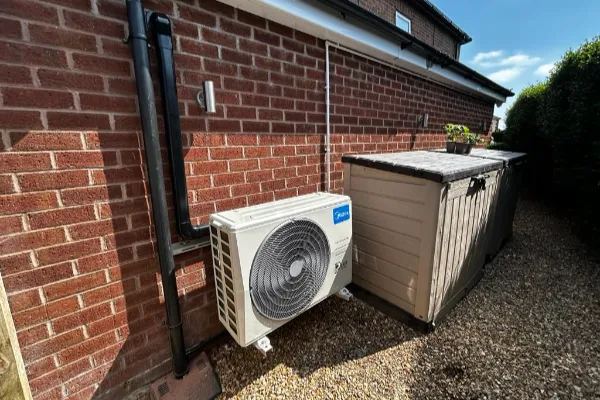
The outdoor unit needs sufficient space for air to move around it. Leaves, garden debris or objects stored too close to the equipment can restrict airflow and affect performance.
From a safe position, check whether anything is visibly obstructing the unit. Remove loose debris from the surrounding area if you can do so without touching the equipment.
Don’t open the casing, reach inside or attempt to repair the fan. If the outdoor unit is unusually noisy, appears damaged or isn’t operating as expected, arrange a professional inspection.
If these checks don’t improve the situation, further investigation is likely to be more useful than continuing to experiment with the settings.
Common Reasons Air Conditioning Stops Cooling
When basic checks haven’t helped, the problem may involve a component inside the system or how refrigerant moves between the indoor and outdoor units. Symptoms can sometimes point to a likely cause, but several faults can produce similar results.
An engineer will need to assess the equipment before confirming what’s wrong. That matters because replacing a part based on a guess can leave the original problem unresolved.
- Low Refrigerant or a Leak
Refrigerant is essential to the cooling process. If the system has lost refrigerant through a leak, it may struggle to remove heat from the room effectively. You might notice the air is only slightly cool, cooling takes longer than usual, or the system no longer performs as it once did.
Refrigerant should not simply disappear during normal operation. If levels are low, investigate the cause rather than treat a top-up as a permanent fix.
A qualified engineer can check the system, identify whether a leak is present and determine the appropriate repair. Only appropriately qualified professionals should carry out work involving refrigerant. GOV.UK explains the relevant F-Gas qualifications for air conditioning work.
- Frozen Indoor Coil
Ice forming around the indoor unit or its coil can prevent air conditioning from cooling properly. Restricted airflow, dirty filters and refrigerant-related faults can all contribute to freezing.
If you notice ice, switch off the cooling function and arrange advice from an engineer. Don’t try to chip the ice away or use a sharp object to speed up defrosting, as this could damage the equipment.
You may also notice water dripping once the ice begins to melt. If the problem returns after the system has thawed, it needs proper investigation rather than repeated restarting.
- Faulty Fan, Capacitor or Compressor
Your air conditioning relies on several components to move air and transfer heat. If a fan isn’t operating correctly, airflow or heat transfer can be affected. Electrical problems, including a faulty capacitor, can also prevent parts of the system from starting or running properly.
The compressor is another important component. If it isn’t operating correctly, the system may run without delivering effective cooling.
These faults aren’t suitable for DIY repairs. Electrical components can be dangerous, and a compressor problem needs proper diagnosis before anyone can advise whether repair or replacement makes sense.
- Sensor and Control Problems
Air conditioning systems use sensors and controls to monitor temperatures and manage operation. If a sensor gives an inaccurate reading or a control develops a fault, the unit may behave unexpectedly.
For example, the system might stop cooling before the room reaches the intended temperature or fail to respond properly to adjustments.
These symptoms can resemble other faults, so an engineer will need to test the relevant components. Once the cause is identified, the repair may be straightforward, depending on the part involved and its availability.
Could the Unit Simply Be the Wrong Size?
Sometimes the equipment is working as intended, but it was never quite right for the room. A unit that’s too small for the space may struggle during hot weather, particularly if the room has large windows, limited insulation or significant heat gain.
You may notice that the system runs for long periods without making much difference to the temperature. This doesn’t automatically mean the unit is faulty, but it is worth investigating if performance has always been disappointing.
A system that was suitable when first installed may also face different demands after a room has been extended, its use has changed, or additional heat-producing equipment has been introduced.
An engineer can assess the room and the system’s performance to establish whether there’s a fault or a capacity issue. If the equipment is genuinely undersized, repairs alone won’t resolve the underlying problem. A replacement may eventually be worth considering, but that decision should follow an assessment, not an assumption.
When to Call an F-Gas Engineer
If the simple checks haven’t helped, or you notice ice, persistent leaks, unusual noises or signs of an electrical problem, it’s time to arrange professional advice.
Also avoid using the system if you suspect a serious electrical fault or notice burning smells. Switch it off if safe to do so and seek appropriate assistance.
Refrigerant work must be handled by professionals with the relevant qualifications. This includes tasks such as checking for leaks, recovering refrigerant and servicing equipment containing F-gas. GOV.UK provides further information about qualifications required to work on F-gas equipment.
When booking a repair, describe what the unit is doing rather than trying to diagnose it yourself. Explain whether the air is completely warm or only slightly cool, whether airflow has changed and if you’ve noticed ice, leaks or unusual sounds. These details give the engineer a useful starting point.
How Regular Servicing Prevents Cooling Problems
Routine servicing can help identify issues before they cause a noticeable loss of cooling. Filters and accessible components can be checked, the system’s performance can be assessed and developing faults may be spotted before they lead to a breakdown.
The appropriate servicing schedule depends on the equipment, its condition and how frequently it’s used. A system that runs for long periods in a busy commercial space may have different maintenance needs from one used occasionally in a spare bedroom.
It’s also worth keeping the outdoor unit clear and following the manufacturer’s guidance for basic care between visits. These small steps support normal operation without replacing the need for professional maintenance.
If your air conditioning has gradually become less effective, don’t wait for it to stop working altogether before arranging an inspection. Professional air conditioning servicing and maintenance can help establish the condition of the system and whether anything needs attention.
Should You Repair or Replace?
A cooling problem doesn’t necessarily mean you need a new unit. If the equipment is in reasonable condition and the fault can be repaired at a sensible cost, keeping the existing system may be the most practical option.
Replacement becomes worth considering when breakdowns are frequent, key parts are hard to obtain, or repair costs are disproportionate to the system’s age and condition.
It’s helpful to compare the likely repair cost with the equipment’s expected reliability going forward. You should also consider whether the system still suits the room and whether its performance meets your needs.
An experienced engineer should explain the available options clearly. The aim is to decide based on the condition of your air conditioning, not to replace a system simply because something has gone wrong.
Air Conditioning Repairs Across Staffordshire
At Staffordshire Air Conditioning Services, we provide repair, installation and maintenance support for domestic and commercial air conditioning systems across Staffordshire. Our F-Gas-certified engineers can investigate problems such as poor cooling, leaks and unusual noises, helping identify the cause before recommending the next step.
We also carry common spare parts to resolve straightforward faults quickly when the required component is available. If your system needs more than a simple repair, we’ll assess the problem and explain the options so you can make an informed decision.
Whether your air conditioning has stopped cooling completely or has gradually become less effective, we aim to restore reliable operation with as little disruption as possible.
Get Your Air Conditioning Cooling Again
If your air conditioning isn’t cooling properly, start with simple checks, but don’t ignore persistent problems. Incorrect settings or dirty filters may be easy to address, while refrigerant leaks, frozen coils and electrical faults need professional attention.
At Staffordshire Air Conditioning Services, we can help you identify what’s affecting your system and advise whether a repair, servicing visit or further investigation is needed. With more than 20 years of industry experience and support for domestic and commercial customers, we can provide practical advice based on your equipment and its condition.
Visit our repair, installation and maintenance page to learn more about our services, or contact our team to discuss the problem and arrange a visit.